He Said It Was "Obliterated." Then He Started Another War Over It.

👋 Hey y'all, welcome back to The Mar-a-Loco Report.
Okay, first things first — I owe you an explanation.
It has been a while. Life got in the way, the news cycle got overwhelming, and honestly, figuring out how to keep up with everything happening in this country without burning out is something I'm still learning. But I'm back now, and I'm committed. Starting today, you can expect a new post every single month. No more disappearing acts. No more radio silence. Just consistent, researched, receipt-backed coverage of the things that matter — delivered to you on a schedule you can count on.
I appreciate every single one of you who stuck around. It means more than you know.
Now. Let's talk about what's been happening while I was gone — because a lot has happened. And one story in particular I couldn't let slide without a full breakdown.
This month, we're talking about Trump's war on Iran. Specifically: what it's costing you right now, why the justification he gave us was contradicted by his own government before the first bomb fell, and why Congress couldn't stop it, by just seven votes.
I want to walk through this slowly, because the story is even wilder than the headlines suggest.
Let's get into it.
🕳️ The Contradiction That Started Everything
Let's start with the thing that nobody in mainstream coverage is saying clearly enough.
Between January 8 and February 13, 2026 — less than three weeks before the war started — Trump used the word "obliterate" in seven different formulations to describe what June 2025's Operation Midnight Hammer had done to Iran's nuclear program. Here are three of them, verbatim:
"We knocked out the Iran nuclear threat, and it was obliterated." — Jan. 8, 2026
"…obliterated Iran's nuclear enrichment capability." — Jan. 20, 2026
"…achieving total obliteration of the Iran nuclear potential capability — totally obliterated." — Feb. 13, 2026
Then, on February 24 — four days before launching a new war — Trump stood in the House chamber for the State of the Union and told Congress that Iran was rebuilding its nuclear program and developing missiles that could "soon reach the American homeland."
So, which is it?
Either it was obliterated, or it wasn't. Either the threat was so total that last summer finished the job, or it was so alive and growing that it required another war. You cannot have both.
CNN ran an analysis on this exact contradiction on February 24 — before the bombs fell. The headline: "Trump said Iran's nuclear program was 'obliterated.' So why is he looking to strike again?" And they found the answer in a detail buried in a White House document from November 2025. That document — from his own administration — said the June strikes had "significantly degraded" Iran's nuclear program.
Not obliterated. Degraded.
That one word is the whole story.
🧾 What His Own Government Said
Here's where it gets bulletproof.
The 2025 U.S. Intelligence Community Worldwide Threat Assessment — compiled by Trump's own Director of National Intelligence, Tulsi Gabbard, and presented to Congress — stated:
"We continue to assess Iran is not building a nuclear weapon and that Khamenei has not reauthorized the nuclear weapons program he suspended in 2003."
That's not a Democratic talking point. That's the official, classified assessment of U.S. intelligence agencies, delivered under oath to the Senate.
When Trump was directly confronted with that assessment after the strikes began, he said: "I don't care what she said... I think they were very close to having one."
His own intelligence director's assessment. Dismissed. With "I don't care."
The IAEA Director General — the head of the international body whose literal job is monitoring nuclear programs — said on March 2: "We don't see a structured program to manufacture nuclear weapons" in Iran.
The Bulletin of the Atomic Scientists reviewed satellite imagery of Iran's nuclear sites and found: "a few modest buildings being rebuilt, but no substantial effort to restore facilities previously damaged or destroyed."
On the missile claim — that Iran could "soon" reach the American homeland — FactCheck.org, PolitiFact, and PBS NewsHour all ran independent fact-checks and found the same thing. The Defense Intelligence Agency's own 2025 assessment said Iran could develop a long-range ICBM by 2035, conditionally, "if it chooses to pursue the capability." That's a decade away. And conditional.
Tehran is 10,000 kilometers from Washington, D.C. Iran's missiles have a range of 2,000 kilometers.
Arms Control Association Executive Director Daryl Kimball put it plainly: "The U.S. intelligence community has been making a similar assessment since the mid-1990s. A decade or more is not 'soon.'"
And then there's the question of diplomacy. On February 26 — two days before the bombs fell — U.S. and Iranian negotiators were sitting at a table in Geneva. The Omani mediator, who was running the talks, said they were making "substantial progress." A fourth round of technical meetings had been scheduled for the following week.
The Arms Control Association reviewed the full timeline and concluded: "By the time the third round of talks ended in Geneva, Trump had likely already made the decision to go to war. It is unlikely that any outcome short of complete Iranian capitulation would have averted the strikes."
The war was happening regardless. The talks were theatrical.
⚖️ He Didn't Have the Authority
This part matters — not as a technicality, but as a fundamental question about who gets to send Americans to die.
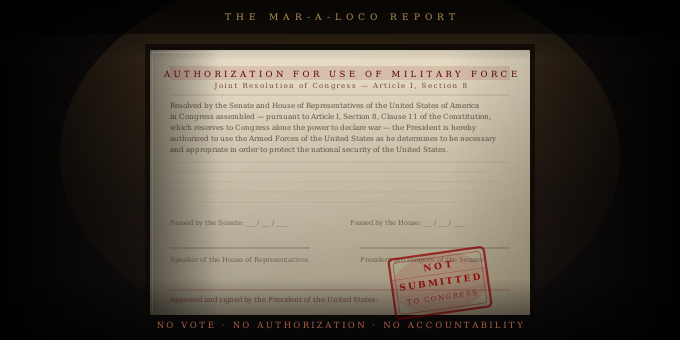
The U.S. Constitution is not ambiguous on this. Article I, Section 8 gives Congress — not the president — the sole power to declare war.
The Brennan Center for Justice: "Trump acted unilaterally and lawlessly — without congressional authorization and absent any imminent threat to the United States. There was no congressional debate, let alone authorization."
The ACLU: "What he failed to mention was that he doesn't actually have the power to declare war; only Congress does."
The Constitution Project at POGO put it plainly in TIME Magazine: "This is a contemplated attack against a sovereign state — an act of war. The Constitution gives the exclusive power to declare war to Congress, not the president."
The War Powers Resolution of 1973 — passed specifically to prevent presidents from doing exactly this — requires congressional notification within 48 hours and congressional approval within 60 days. Secretary of State Rubio's response? "We notified the Gang of Eight. There's no law that requires us to do that." (There are multiple laws. That's one of them.)
Congress tried to assert itself. Democrats, joined by Sen. Rand Paul (R-KY), pushed War Powers resolutions in both chambers.
The Senate voted. 47 to 53. Failed.
The House voted. 212 to 219. Failed.
Seven votes. That's the margin between the Constitution being enforced and a president going to war on his own. Almost entirely along party lines. Republicans held the wall, with one exception in each chamber.
The Brennan Center's conclusion after watching this play out: "This Congress has led us into uncharted waters by totally abdicating its constitutional role in the face of a president uniquely inclined toward executive overreach."
⛽ What This War Is Costing You Right Now
Okay. Constitutional law is important. But let me talk about your wallet, because this war is hitting ordinary Americans in ways that don't always get connected back to the decision made on February 28.
Gas prices
The national average for regular gas was $2.98/gallon right before the war started — Trump's signature economic talking point, the lowest since May 2021. He bragged about it constantly.
As of March 16, it's $3.72/gallon. That's a 74-cent surge in 17 days — the largest monthly increase since Hurricane Katrina, according to AAA and CNN Business.
Diesel hit $5.04/gallon on March 17 — a 34% increase from pre-war levels and the highest since December 2022.
Why does diesel matter even if you drive a gas car? Because diesel powers everything you buy. Every truck. Every freight train. Every cargo barge. When diesel spikes 34%, the cost of shipping every product in America goes up — and businesses pass that cost to you at the register.
Oil prices peaked at $126 per barrel — the first time above $100 in four years, and what Rapidan Energy characterized as the largest oil supply disruption in history, more than double the previous record set in the 1950s.
When asked on March 7 about rising gas prices, Trump told Reuters: "If they rise, they rise." Then he told the New York Post that gas prices are "a very small price to pay for U.S.A., and World, Safety and Peace."
Tell that to the person filling up their tank to get to work.
Inflation and your mortgage
Before the war, inflation had fallen to 2.4% — an eight-month low. Goldman Sachs had been projecting it would ease to 2% by year-end. That forecast is now gone.
Goldman Sachs now projects inflation could snap back to 3% if the war drags on. JPMorgan economists put the same number on it. EY-Parthenon's chief economist estimated the gas price bump alone could push monthly inflation as high as 1.0% in March — the highest monthly figure in four years.
Meanwhile, mortgage rates that had just fallen below 6% for the first time since 2022 — a huge deal for homebuyers who'd been locked out of the market — reversed course. They climbed from 5.99% on February 27 to 6.29% by March 12. In less than two weeks. That's real money on every new home purchase.
The Federal Reserve is now boxed in. It can't cut rates to stimulate the economy because the energy shock is pushing inflation back up at the same time. Moody's chief economist Mark Zandi said it clearly: "Higher oil prices are another negative supply shock, lifting inflation and hurting growth — putting the Fed in a no-win situation. There's no upside. There's just nothing but downside here for the US economy."
Your groceries (this one's coming)
The Strait of Hormuz closure is about to hit your grocery bill, too. Gulf states produce 49% of global urea exports — that's the most widely used nitrogen fertilizer — and 30% of global ammonia. Urea prices have already jumped 35% since February 28.
The American Farm Bureau issued a formal warning that the U.S. "risks a shortfall in crops." The Red Sea — which had been expected to reopen in 2026 after 2025 Houthi disruptions that would have lowered consumer prices — will now remain closed indefinitely.
Georgetown economics professor Robert Rogowsky was direct about who gets hit hardest: lower-income Americans, he said, "will pay the price for this inflationary burst."
The literal price tag on this war
The first week alone cost U.S. taxpayers over $11 billion — and that doesn't include the months-long military buildup that happened before February 28.
13 U.S. service members are dead as of March 17. Seven killed by enemy fire. Six in a military aircraft crash that the Pentagon is still investigating.
And on March 17 — today — the Director of the National Counterterrorism Center resigned. His stated reason: Iran posed "no imminent threat" to the United States. That is the intelligence community's own leadership publicly saying the justification for this war was wrong. After it had already started.
📊 What Americans Actually Think
This is also important context, because Trump dismissed all of it.
Across eight independent polls conducted in the first two weeks of the war, the results are strikingly consistent:
- Reuters/Ipsos: 27% approve, 43% disapprove
- NPR/PBS Marist: 44% support, 56% oppose
- CNN/SSRS: 41% support, 59% oppose
- Quinnipiac: 40% support, 53% oppose
- Fox News (the most favorable polling for Trump): 50/50 split
That's a majority or plurality opposing this war in every single poll except Fox, which still shows it tied, not popular.
74% of Americans oppose sending ground troops into Iran, including 52% of Republicans (Quinnipiac, March 6–8). 70% say Trump needs congressional authorization to continue (CBS News). 55% see Iran as a "minor threat or no threat at all" — not a major threat (NPR/Marist).
And 45% of respondents — including 34% of Republicans — said rising gas and oil prices would make them more likely to oppose the war (Reuters/Ipsos).
Trump's response to all of this, in his own words, to the New York Post on March 2:
"I don't care about polling. I have to do the right thing."
🔁 We've Seen This Before
I want you to sit with this for a second.
In 2003, the Bush administration told us Iraq had weapons of mass destruction. That claim turned out to be false. Congress voted — but based on intelligence that was manipulated to support a conclusion that had already been reached. That war cost 4,400+ American lives, over $2 trillion in taxpayer money, and destabilized an entire region for two decades.
Here's the key difference in 2026, flagged by analysts across the political spectrum:
In 2003, U.S. intelligence was distorted to fit the argument for war.
In 2026, the intelligence openly contradicted the argument — and Trump went to war anyway.
That is not a small distinction. That's actually worse. Because in 2003, a case was being built, however dishonestly. In 2026, the intelligence community said clearly: " This doesn't justify what you're about to do. And it happened anyway.
📌 The Bottom Line
I'm not going to bury this.
Donald Trump started a war that his own intelligence community said wasn't necessary. He did it without asking Congress. His own envoy was still in negotiations when the decision had likely already been made. Congress tried to invoke the Constitution, but Republicans blocked it by a 7-vote margin in the House. The war has now killed 13 Americans, cost over $11 billion in its first week, sent gas prices surging nearly a dollar a gallon, reversed progress on inflation and mortgage rates, disrupted global food supply chains, and crashed the stock market — while Iran's foreign minister says they "never asked for a ceasefire" and will fight "as long as it takes."
The Director of the National Counterterrorism Center just resigned over it today.
None of this is partisan analysis. All of it is documented. The gas prices come from AAA. The intelligence assessments come from the U.S. DNI and DIA. The legal analysis comes from constitutional scholars across the spectrum. The polling comes from Reuters, Quinnipiac, NPR, CBS, and Fox.
The only thing connecting all of these facts is that one person made one decision, without permission, on February 28, 2026.
We don't have to accept this as normal. And the least we can do is refuse to look away.
Subscribe. Share. Stay loud.
Cole
Founder, The Mar-a-Loco Report
Sources
- AAA / GasBuddy — Gas price data before and during the war → gasprices.aaa.com
- Bureau of Labor Statistics — CPI inflation data, January 2026 → bls.gov/news.release/cpi.nr0.htm
- U.S. Intelligence Community Worldwide Threat Assessment (2025) — Official finding: Iran "is not building a nuclear weapon" → dni.gov/files/ODNI/documents/assessments/ATA-2025-Unclassified-Report.pdf
- Defense Intelligence Agency Missile Threat Assessment (May 2025) — Iran could develop an ICBM by 2035 if it chooses to → dia.mil/News/Articles/Article-View/Article/3801555
- Arms Control Association — Full diplomatic timeline; war decision preceded talks collapsing → armscontrol.org/blog/2026-03-11/us-negotiators-were-ill-prepared-serious-nuclear-negotiations-iran
- IAEA Director General Rafael Mariano Grossi, March 2, 2026 — "We don't see a structured program to manufacture nuclear weapons" → iaea.org/newscenter/pressreleases
- Bulletin of the Atomic Scientists — Satellite imagery: no substantial nuclear rebuild → thebulletin.org/2026/02/trumps-war-on-iran-grave-dangers-and-at-best-limited-benefits
- Brennan Center for Justice — Trump "acted unilaterally and lawlessly — without congressional authorization" → brennancenter.org/our-work/analysis-opinion/trumps-iran-strikes-are-unconstitutional
- ACLU — War powers constitutional analysis → aclu.org/news/civil-liberties/your-questions-answered-can-congress-stop-president-trumps-illegal-war-against-iran
- Constitution Project at POGO / TIME Magazine, Feb. 28, 2026 — "This is a contemplated attack against a sovereign state — an act of war" → time.com/7380309/iran-war-legal-trump
- FactCheck.org — Missile and nuclear claim fact-checks; Strait of Hormuz economic impact → factcheck.org/2026/03/assessing-trumps-claims-on-irans-nuclear-and-missile-capabilities
- PolitiFact — "Soon reach U.S. homeland" missile claim fact-check → politifact.com/article/2026/feb/28/United-States-Israel-Iran-attack-nuclear-missiles
- PBS NewsHour — Trump justification fact-check; consumer price impact analysis → pbs.org/newshour/politics/fact-checking-statements-made-by-trump-to-justify-u-s-strikes-on-iran
- CNN Business — Gas price surge data; "obliterate" contradiction analysis → cnn.com/2026/02/24/politics/nuclear-program-iran-trump-strike
- Reuters/Ipsos Poll, Feb. 28–Mar. 1, 2026 — 27% approve, 43% disapprove of strikes → ipsos.com/en-us/more-americans-disapprove-approve-us-strikes-against-iran
- Quinnipiac University Poll, March 6–8, 2026 — 53% oppose strikes; 74% oppose ground troops → poll.qu.edu/poll-release?releaseid=3952
- NPR/PBS Marist Poll, March 3–5, 2026 — 56% oppose military action; 55% see Iran as minor or no threat → npr.org/2026/03/06/nx-s1-5737627/iran-us-military-poll-trump-approval
- CBS News/YouGov, Feb. 28–Mar. 3, 2026 — 70% say Trump needs congressional authorization → cbsnews.com/news/cpi-report-today-february-2026-inflation-iran-war-trump
- Goldman Sachs / JPMorgan — Inflation could snap back to 3% if war drags on → cnn.com/2026/03/09/business/prices-oil-iran-war-affordability
- Moody's Analytics — Mark Zandi — "There's no upside. There's just nothing but downside here for the US economy." → cnbc.com/2026/03/10/iran-war-spikes-oil-prices-consumers
- TIME Magazine, March 13, 2026 — First-week war cost: $11B+; fertilizer prices; airline costs → time.com/article/2026/03/13/war-iran-us-israel-cost-hormuz-gas-oil-electricity
- NPR, March 15–17, 2026 — U.S. service member deaths; NCTC director resignation → npr.org/2026/03/15/nx-s1-5748472/us-military-six-killed-iran-war
- NBC News, March 4, 2026 — Senate War Powers vote: 47–53 → nbcnews.com/politics/congress/senate-blocks-restrictions-trump-using-military-iran-war-rcna261680
- Al Jazeera, March 5, 2026 — House War Powers vote: 212–219 → aljazeera.com/news/2026/3/5/us-house-narrowly-rejects-resolution-to-end-trumps-iran-war
- American Farm Bureau — Fertilizer disruption; U.S. crop shortfall warning → time.com/article/2026/03/13/war-iran-us-israel-cost-hormuz-gas-oil-electricity